UK Betting for Horse Racing: The Complete 2026 Punter’s Guide
A market of record Levies, falling turnover, and a regulator caught in the middle.
 Available in US
Here is the strangest picture in British sport right now. Remote betting in the UK generated £2.6 billion in Gross Gambling Yield for the financial year to March 2025, and £766.7 million of that came from horse racing alone. A record. Over the same window, betting turnover on British racing fell by 9% in Q1 2025 compared with the same quarter a year earlier. The Levy that bookmakers pay back to the sport hit an all-time high of £108.9 million — the best yield since the 2017 reform. Meanwhile, the people putting money on actual horses are, by the industry’s own measure, placing less of it.
I have spent nine years working in form analysis, market movements, and the regulatory weather of British racing. The paradox above is the thing I get asked about most often at the bar on a festival evening, and it is the lens I want you to hold onto while reading this guide. What the top-ten search results tell you about UK horse racing betting — bet types, welcome offers, a line on Cheltenham — is true but hollow. It does not explain why the sport is booming in pay-in and quietly bleeding in participation. It does not explain why your account might get a stake-restriction letter after three winning Saturdays. It does not explain why a record £450 million is expected to be wagered over four days at Cheltenham while the Grand Stand at a Wednesday fixture in October looks half empty.
This guide gives you the full field. How odds work in Britain. The bet types that are genuinely useful and the ones that just sound clever. The shape of the calendar from Flat to Jumps. The festivals where the money actually moves. How to pick a bookmaker without falling for the branding. Who regulates whom — and the uncomfortable bit the homepage never mentions: affordability checks, the growing black market, and the safety net you are entitled to lean on. By the end you will read a market the way I read it, which is less “who will win” and more “what is this price telling me, and who set it”. Reins in hand.
Table of Contents
- The Pillar in a Hundred Words
- Why the UK Market Sits in a Category of Its Own
- How Horse Racing Odds Actually Work
- The Bet Types Every UK Punter Should Know
- Reading the Calendar: Flat and Jumps
- The Festivals That Shape the Betting Year
- Choosing a Bookmaker Without Falling for the Shop Window
- Best Odds Guaranteed, Extra Places, and Everything in Between
- Who Actually Runs This Sport: UKGC, BHA, and HBLB
- Affordability Checks and the Shadow They Cast
- Staying in Control: The Tools the UK Actually Gives You
- Questions Punters Ask Me Most
The Pillar in a Hundred Words
- UK racing betting generated £766.7m of a £2.6bn remote-betting GGY in FY 2024–25, yet turnover fell 9% in Q1 2025 — a paradox driven by affordability checks, not lack of interest.
- Fixed-odds bookmakers dominate; the Tote pool accounts for roughly 5% of turnover.
- Choose bookmakers on BOG, extra places, price consistency, account policy, and payout speed — not welcome offers.
- Levy hit a record £108.9m in 2024–25; three regulators — UKGC, BHA, HBLB — share the rope.
- Supply affordability documents to licensed operators; never migrate to an unlicensed site.
Why the UK Market Sits in a Category of Its Own
A French friend of mine once asked me, over a pint at Sandown, why British punters almost never talk about pool betting. In France, the PMU pool is the main event — the tote dictates the price and everyone plays against everyone else. Here, fixed-odds bookmakers own the conversation. Pool betting through the Tote accounts for roughly 5% of UK racing turnover. Everything else is you versus a bookmaker. That single structural fact explains more about British racing than any other.
British racing is not just a sport with some betting bolted on. It is an economy. Direct revenue from the industry runs past £1.47 billion a year. Total contribution — direct, indirect and induced — is £4.1 billion. It supports around 85,000 jobs, with more than 20,000 working directly at 59 licensed racecourses and 500+ training yards. After football, it is the second most-watched sport in the country. The 2025 calendar delivered 5,031,640 paying attendees, the first time the five-million mark has been cleared since 2019. The 211,447 under-18 visits — a 17% jump — matter too: this is a live audience, not a heritage audience.

The two-engine market
UK racing betting runs on two parallel rails. The first is fixed-odds bookmaking, where you take a price and that price is your contract — win or lose. The second is the Tote, a parimutuel pool where all stakes go into a single pot and the dividend is worked out after the race. Fixed-odds dominates; the Tote survives as a specialist pool for exotic bets like the Placepot and Quadpot. Which engine you are playing on changes how you think about value.
The other thing that makes Britain different is the Levy. Since 1961 — reformed in 2017 to cover offshore operators — bookmakers with annual gross profit on British racing over £500,000 pay 10% of that profit back into the sport through the Horserace Betting Levy Board. That money funds prize money, veterinary research, integrity, and retraining for ex-racehorses. No other major British sport has a comparable statutory levy in primary legislation.
And yet here is the concerning bit. “Total betting turnover has fallen by nine per cent compared with the same period in 2024,” said Richard Wayman, Director of Racing at the BHA, in May 2025. “Whilst there is work to be done on the racing product to grow its appeal as a betting medium, there would be a much wider range of factors contributing to this concerning decline.” Those factors are the subject of the later sections — affordability checks, account restrictions, and the migration of bettors to unlicensed sites.
£2.6 bn
Remote betting GGY, UK, FY 2024–25
£766.7 m
Horse racing share of remote betting GGY
£4.1 bn
Total economic contribution of British racing
85,000
Jobs supported across the industry
5.03 m
Attendance across 2025 fixtures
5%
Share of turnover going through the Tote
Put these numbers next to each other and the British market reveals itself. It is a fixed-odds market, heavily regulated, tied to a unique funding mechanism, commercially enormous, and under internal strain. If you came expecting a clean “top ten bookmakers” listicle, you are about to be disappointed, which is rather the point.
How Horse Racing Odds Actually Work
I once watched a newcomer at Goodwood, holding a betting slip that read “4/1”, staring at it as if it were a Rosetta Stone fragment. He asked me whether 4/1 meant he had won four pounds or four pence. This is the single most common blind spot I see, and it is entirely the industry’s fault for keeping fractional notation alive into the decimal age.
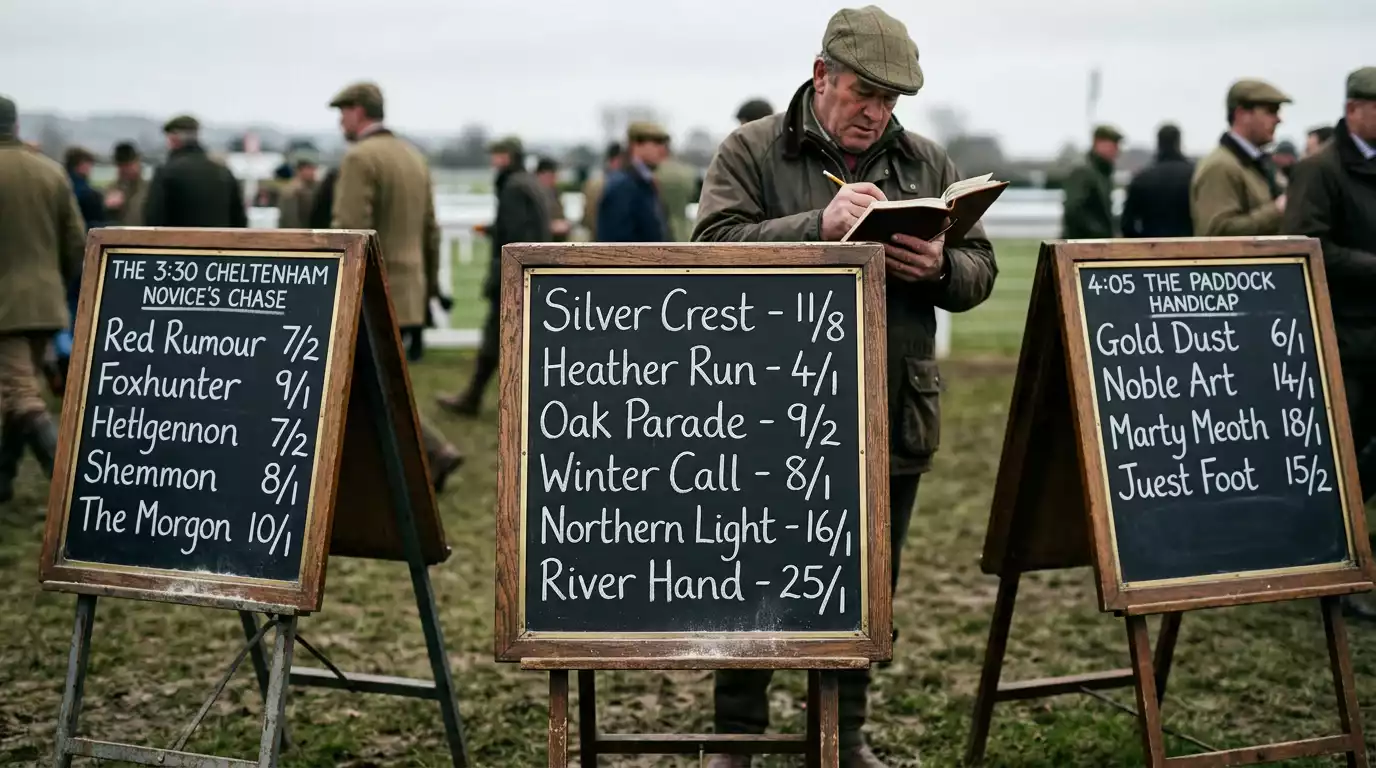
Here is the translation you actually need. Fractional odds tell you profit relative to stake. A price of 4/1 means for every £1 you risk, you win £4 in profit, plus your £1 back, for a total return of £5. A price of 11/8 means for every £8 risked, you win £11 profit. Decimal odds fold everything into a single multiplier. Decimal 5.00 on a £1 stake returns £5 total, the same as 4/1. The arithmetic is identical.
Reading a price at a glance
| Fractional | Decimal | £10 stake returns |
|---|---|---|
| Evens (1/1) | 2.00 | £20 |
| 11/8 | 2.375 | £23.75 |
| 4/1 | 5.00 | £50 |
| 20/1 | 21.00 | £210 |
| 100/30 | 4.33 | £43.30 |
Now the concepts that actually matter once you understand the arithmetic.
Starting Price (SP) — the official price returned at the moment the race begins, based on the range of prices available in the on-course betting ring. It is the fall-back price for bets placed without a specified price.
Board Price — the price shown on the bookmaker’s board or website before the off. Once you accept it, that price is locked on your slip regardless of what the SP becomes.
Implied Probability — the probability a price represents. The formula is 1 divided by decimal odds. A 4/1 shot (decimal 5.00) implies a 20% chance. Add up all implied probabilities in a race and they total more than 100%; the overshoot is the bookmaker’s margin, known as the overround.
The overround is where the sport gets interesting for the thinking punter. In a competitive eight-runner handicap, a sharp bookmaker might price the race to a 108% book — meaning a theoretical margin of 8%. An exchange such as Betfair, where punters price each other, frequently runs closer to 100.5%. The implication is straightforward: if you routinely take a fixed-odds price worse than the exchange equivalent by more than a couple of ticks, you are paying a tax you do not need to pay on every bet.
One last mechanical point. UK racing pays winning bets on the larger of board price or SP if you took SP, and pays board price if you took board price — unless the operator offers Best Odds Guaranteed. For Flat and Jumps alike, fields of eight or more runners pay three places on each-way bets; handicaps of 16+ pay four. Remember those numbers. They decide whether an each-way staking plan makes sense.
The Bet Types Every UK Punter Should Know
The best bet I ever turned down was a Lucky 15 at Ascot in 2019. The worst bet I ever placed was the same Lucky 15. I had worked out that one leg was heavily overpriced, declined to load it up as an acca with three weaker choices, walked away, and sat watching as all four came in. The moral is not “play more multiples”. Bet types are tools, and picking the wrong tool for the race in front of you is the single most expensive habit a British punter can develop.
Five bet types cover 95% of UK racing betting: win, each-way, place, forecast, and multiples.
A win bet is the simplest thing on the card. You back a horse to finish first. If it wins, you get paid at the price you took; if it does not, your stake goes to the bookmaker. The mistake I see punters make with win bets is taking them on 20-runner handicaps at 16/1 when a smaller each-way stake would have delivered a better outcome on balance.
An each-way bet is two bets in one — half your stake on the horse to win, half on it to “place”. Fields of eight or more runners pay three places; handicaps with 16+ pay four; smaller fields pay two or none. The place portion typically pays at 1/4 or 1/5 of the win odds. Each-way works well on mid-priced horses in competitive fields; it is wasted on short-priced favourites, where the place return barely covers the stake.
| Factor | Win-only | Each-way |
|---|---|---|
| Stake unit | £10 single | £10 each-way (= £20 total) |
| Best at odds | Evens to 4/1 | 6/1 and drifting |
| Best field size | Any, especially small fields | 8+ runners, ideally handicaps 16+ |
| If horse wins | Full profit at taken price | Profit on both parts, at win and place fractions |
| If horse places | Stake lost | Place portion paid; win stake lost |
A place bet is available on selected races. You back the horse to finish in the paid places — no win component. Stand-alone place betting is more common on the Tote and through exchanges than with traditional bookmakers, and it is the right tool when your view is “this horse will run into the frame but I cannot say it will win”.
Forecast — a bet naming the horses to finish first and second in the correct order. A “reverse forecast” doubles the stake to cover both orders. A Tricast extends this to first, second, and third — offered on non-handicaps with eight or more runners.
Then there are multiples, which is where punters either make a week’s wages or hand theirs back. A double is two selections, a treble three, an accumulator four or more — all must win. A Lucky 15 takes four selections and covers every possible combination — 15 bets. A Trixie is four bets from three selections (three doubles plus one treble). A Yankee is 11 bets from four selections, with no singles.
Bookmaker multiples versus Tote exotics
Fixed-odds multiples are settled by multiplying each leg’s price. Tote exotics — Placepot, Quadpot, Jackpot — are pool bets where you pick placed horses across six races or the middle four and share a dividend calculated after all results are in. Multiples pay the price you took; Tote exotics pay whatever the pool returns.
There is considerably more to say about each market — when a Lucky 15 genuinely earns its keep, why forecasts are often mispriced on rain-softened ground, where Tote returns reliably beat SP. I have written at length on the mechanics and numerical edges in the full breakdown of UK horse racing bet types. The pillar takeaway is narrower: pick your bet type to fit the race in front of you, not the other way round.
Reading the Calendar: Flat and Jumps
Ask ten British punters which they prefer — Flat or Jumps — and seven will tell you National Hunt without hesitation. The reason, usually, is atmosphere. A wet Tuesday at Wincanton in January has a defiant romance that a Flat card on an August evening does not reach. But the betting logic differs for each discipline, and treating the calendar as one continuous stream is the sort of thing that costs you money.
Flat racing runs primarily from late March to early November on turf, with an all-weather programme filling the winter on Polytrack and Tapeta. The headline fixtures — Guineas weekend at Newmarket in early May, the Derby at Epsom in early June, Royal Ascot in mid-June, Glorious Goodwood in late July, the Ebor at York in August — cluster in the warmer months. Flat racing rewards raw speed over distances from five furlongs to two and a half miles, and draw bias on certain tracks (Chester, Beverley) becomes a real betting factor.
National Hunt — Jumps racing — is primarily a winter sport, with the major action running November through April. Horses carry handicaps over fences or hurdles, ground is typically softer, and stamina outranks pure pace. The core winter calendar runs from the King George VI Chase at Kempton on Boxing Day, through Cheltenham Festival in mid-March, peaking at Aintree in April. Jumps horses mature later than Flat horses and have longer careers, which matters for form study — a nine-year-old chaser may be in his prime.
Dual-code races exist but are rare. A horse that has raced in Jumps and then switches to the Flat carries different form implications on each surface. Frankel never raced over hurdles; Istabraq never saw a Flat card as a senior. Treat them as different sports wearing the same saddle.
The betting consequence is immediate. In Flat racing, the market is tighter — more international money and exchange liquidity. Prices move quickly, value windows close within minutes. In Jumps, markets crystallise more slowly, ante-post shapes form earlier, and the gap between morning and SP prices can be meaningful.
Market structure is one thing. Where the real money moves — and where casual punters flood in — is a different question.
The Festivals That Shape the Betting Year
Every March, the week before Cheltenham, I get three types of phone call. Old friends in the trade swapping whispers about trainer fitness. Journalists needing a quote. And — my favourite — people who have not had a bet all year suddenly wanting to know “which one is Willie Mullins”. This is the power of a festival. It drags casual money in, inflates overround, and rewards the punter who can separate genuine contenders from the gravy.
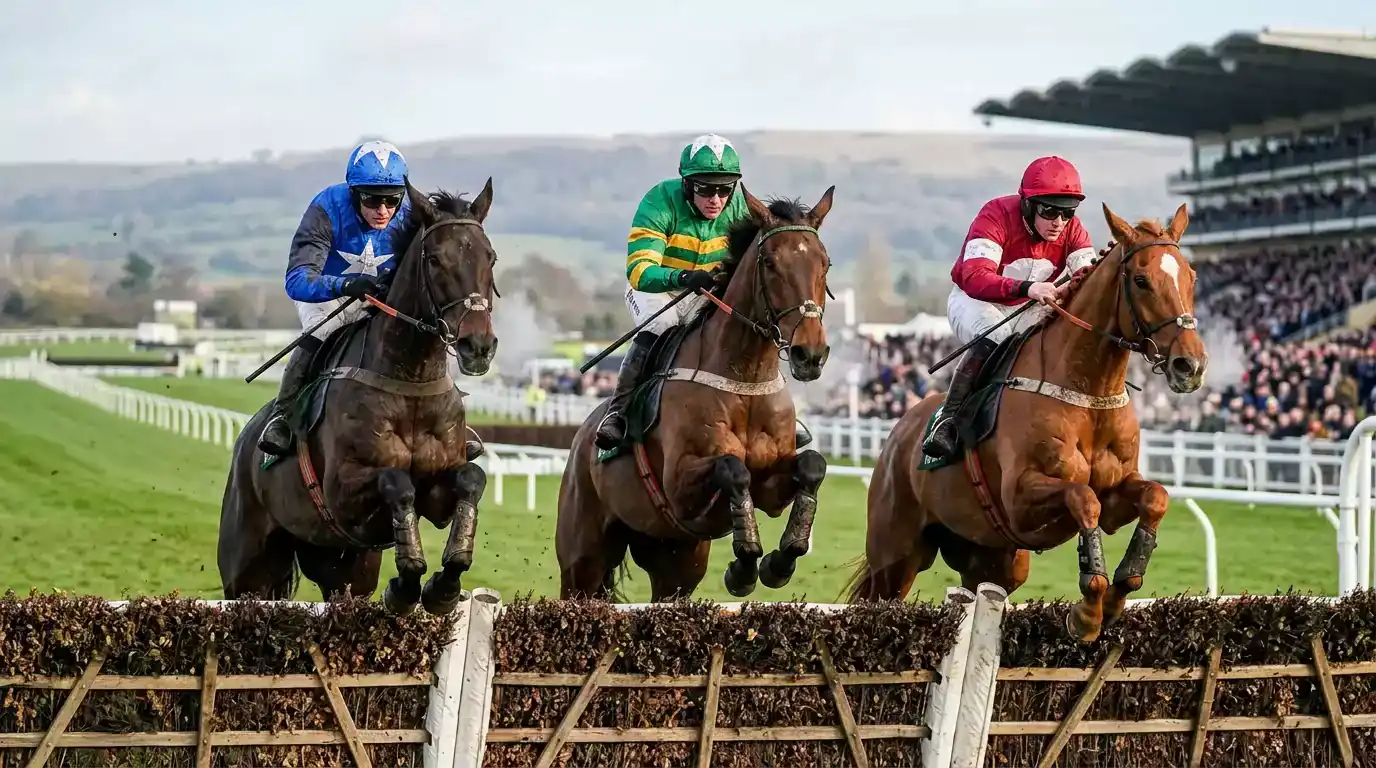
Four festivals dominate the UK betting year.
Cheltenham Festival
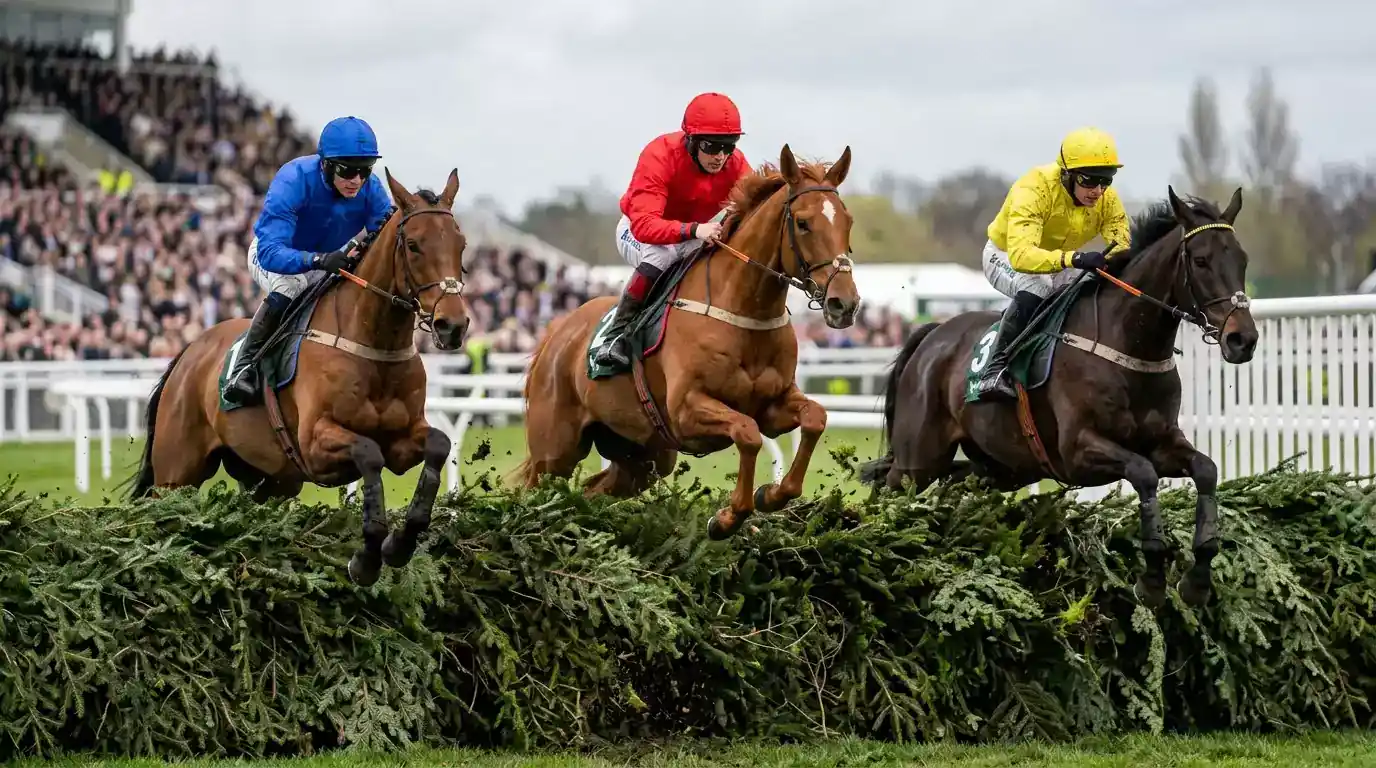
“The battle between us and the punters over the four days of the Cheltenham Festival is unrivalled in Jumps racing,” a William Hill spokesperson said ahead of the 2026 meeting. “We’re expecting around £450 million to be wagered over the four days, which makes it the most bet-on racing festival of the year.” The density drives it: 28 races over four days at Prestbury Park, all 28 inside the top-31 most-bet-on races of 2025. The Gold Cup on Friday is the headline; Champion Hurdle, Queen Mother Champion Chase, and Stayers’ Hurdle are the other Championship races. Irish raiders have dominated recent renewals, and ante-post markets shape up from December.
Grand National at Aintree
The Grand National is the anomaly of the British sporting calendar. An estimated £250 million was wagered on the 2025 running by roughly 12 million British adults — a participation number no other race in the world approaches. About 82% of stakes were £5 or smaller. Around 30% of bettors are first-timers or people returning after a long gap. The race generates up to six times the turnover of the Gold Cup and attracts 700% more bets than the next most popular race.
One race, one nation, one sweepstake. The Grand National is the only sporting event in Britain where the office, the pub, and the family all run the same sweepstake on the same afternoon. A £5 stake on a 40/1 outsider is roughly the modal British bet of the year.
Royal Ascot
Five days in mid-June. Thirty-five races. The only fixture in the world that starts each afternoon with a royal procession. Royal Ascot is the summit of British Flat racing — the Gold Cup on Ladies’ Day (a staying race over two and a half miles), and sprint championships over five and six furlongs. The betting markets pull international liquidity from Australian, Japanese, and American raiders. Ante-post value tends to appear on unraced two-year-olds for the Friday and Saturday juvenile races.
Epsom Derby
One race, in early June, that a generation of owners has targeted since their colt was a yearling. A mile-and-a-half test down Tattenham Corner and up the rising finish at Epsom. The market runs tight, the favourite is usually short, and long-term value — if it exists — is locked in by Christmas of the previous year on horses who have not yet had a two-year-old start.
The festival premium is also a festival tax. Casual money inflates the overround on Grand National Saturday and Cheltenham Tuesday. Prices that would be 8/1 on an ordinary Wednesday become 13/2 because the book has to absorb millions of small stakes on the favourite. Ante-post betting is one way round this, but it carries its own risk: if your horse is withdrawn, your stake is usually lost unless the bookmaker offers Non Runner No Bet.
Festivals are where the market is loudest, not necessarily where the value is. The sharpest punters I know do most of their work on quiet Wednesday cards and use festivals for ante-post positions laid down months earlier.
For a full strategic breakdown of Aintree, see the Grand National betting guide. For Cheltenham — Championship Races, ante-post windows, going reads at Prestbury Park — see the Cheltenham Festival betting guide.
Choosing a Bookmaker Without Falling for the Shop Window
A friend of mine — an actuary who should know better — opened an account with a brand new operator in 2024 because the welcome offer was “a bit tasty”. Three weeks later the operator had gone into administration, his deposit was trapped in dispute, and he had learned the first lesson of choosing a UK bookmaker the hard way. Welcome offers are the least useful criterion. They exist to get you through the door. What matters is what happens after.
The UK market had 3,086 licensed gambling operators on its register as of March 2025, down 2.3% year on year, with around 24.4 million active remote accounts across them. The base question — “is this operator legitimate?” — is worth asking carefully. UK-facing bookmakers must hold a UKGC licence, checkable on the Commission’s public register. If the operator is not there, walk away.
Before you put a pound into any UK bookmaker, verify the following
- UKGC licence — look up the operator’s licence number on the Gambling Commission public register and confirm it covers remote betting.
- Does the operator offer Best Odds Guaranteed on UK and Irish racing, and from what time of day does it apply?
- What is the extra-places policy on Saturday ITV races and festival fixtures?
- Is Non Runner No Bet offered on ante-post markets for the major festivals?
- What deposit and withdrawal methods are supported, and what are typical withdrawal times?
- How does the operator handle stake restrictions, and is there a clear process for appealing them?
- What are the responsible gambling tools on offer — deposit limits, loss limits, time-outs, self-exclusion?
The five criteria that separate a good UK racing bookmaker from a mediocre one:
| Criterion | What to look for |
|---|---|
| Price competitiveness | Board prices on the horses you back match or beat the exchange by fewer than three ticks across a sample of 20 races. Use a sample — never a single race. |
| BOG policy | Best Odds Guaranteed offered on all UK and Irish racing, applied automatically, from an early UK morning cut-off. |
| Extra places | Consistent extra-place promotions on major ITV handicaps. Terms published clearly on the promotion page, not hidden in small print. |
| Account policy | Published criteria for stake restrictions where possible; a clear appeals process; no shadow bans on winning accounts without notification. |
| Payout speed | Withdrawals processed within 24 hours for standard methods; no friction between “bet settled” and “funds available”. |
Notice what is not on that list. Welcome offers. Free bet tokens. The “best site for beginners” badges that affiliates like to sprinkle around. None of those things affect whether you get a good price on a Wednesday handicap in nine months.
One practical note. Almost every sharp punter I know runs accounts with two or three operators rather than one. The reason is price comparison, not arbitrage. Bookmakers price races differently — sometimes by as much as a full point on a 5/1 shot — and if you always take one operator’s price, you are leaving money on the counter. Roughly two to five per cent of returns can be recovered by taking the best of two or three board prices.
A full criteria-by-criteria comparison is set out in the guide to choosing a UK horse racing bookmaker. The framing is simpler: the shop window is the least reliable indicator of quality, and the boring criteria are the ones that pay.
Best Odds Guaranteed, Extra Places, and Everything in Between
There is a specific British punter move I have watched hundreds of times. You back a horse at 6/1 in the morning, the price drifts to 8/1 by the off, and the horse wins. At which price do you get paid? If your operator offers Best Odds Guaranteed, you are paid at 8/1, the SP — the larger of your taken price and the starting price. Without BOG, you are paid at 6/1 and the drift has cost you real money. It is the single most valuable structural promotion in UK racing betting, and worth building your bookmaker selection around.
What Best Odds Guaranteed does, and does not, do
BOG applies to UK and Irish racing, typically from an early morning cut-off (often 08:00 UK time). If your taken price is shorter than SP and your horse wins, you are paid at SP. If your taken price is longer than SP, you keep it. It is free insurance against market drift. BOG does not apply to ante-post bets, bets placed after the off, or enhanced specials, and does not apply to each-way place returns — only the win portion.
BOG in action
| Scenario | Taken price | SP | Paid at |
|---|---|---|---|
| Price drifts | 6/1 | 8/1 | 8/1 (SP — BOG applied) |
| Price shortens | 6/1 | 4/1 | 6/1 (taken price — larger) |
| Exact same price | 5/1 | 5/1 | 5/1 |
| Horse loses | Any | Any | Stake lost regardless of BOG |
The other major punter-side promotion is extra places. On selected races — almost always the headline Saturday ITV handicap, and every race of the Grand National and Cheltenham Festival cards — bookmakers offer additional placed positions on each-way bets. Standard terms pay three places in an eight-plus-runner race; an extra-places promotion might pay four, five, or on the Grand National, sometimes six or seven.
The mechanic is valuable when used correctly. Back an each-way shot at 25/1 in a 20-runner handicap, and if your operator pays six places instead of four, you have two additional shots at the place-portion return without paying more stake. On a competitive Saturday card this compounds meaningfully across a betting bank.
Where punters trip up is the “is it worth chasing the operator” question. Yes, within limits. A bookmaker without BOG is pricing each of your bets fractionally worse than one that offers it — but a bookmaker who offers BOG while consistently pricing races 0.1 points shorter has given the value back with the other hand. BOG alone does not make a good bookmaker. It is a necessary, not sufficient, criterion.
Who Actually Runs This Sport: UKGC, BHA, and HBLB
The first thing to understand about British racing is that no single body runs it. Three organisations hold different pieces of the rope, and their remits overlap in a way that would drive a management consultant to drink. Understanding which body does what tells you more about the politics of UK racing betting than any quote from a bookmaker’s PR team ever will.
The UK Gambling Commission (UKGC) is the statutory regulator of all licensed gambling in Great Britain, established under the Gambling Act 2005. It issues operator licences, technical standards, and personal management licences. It enforces player-protection rules — affordability checks, self-exclusion, deposit-limit prompts, anti-money-laundering. If a bookmaker takes your money in Britain, the UKGC is why it has to give it back. As of March 2025, 3,086 operators held a Commission licence.
The British Horseracing Authority (BHA) is the sport’s governing body — the equivalent of the FA for racing. It writes and enforces the Rules of Racing, licenses trainers, jockeys, and stable staff, oversees drug testing and integrity. The BHA does not regulate betting directly — that is the UKGC’s job — but it sets the product that is bet on and polices the people who produce it.
The Horserace Betting Levy Board (HBLB) is the institutional bridge between the two. It collects the 10% Levy from bookmakers with more than £500,000 in annual gross profit on British racing and redistributes that money to the sport. For 2024–25, the Levy yield reached £108.9 million — a record since the 2017 reform, up from £105.3 million the year before. Of the most recent year’s spend, £66.9 million went to prize money, £19.4 million to regulatory and integrity functions, and £7.9 million to recruitment, retraining, and promotional campaigns. For 2026, HBLB is adding £4.4 million to prize money inside an overall £77.1 million funding package.
Why the fourth body matters. The Betting and Gaming Council (BGC) is the trade association for UK bookmakers, not a regulator. It is the industry’s lobbying voice on policy — affordability checks, tax rates, black-market enforcement. When you read a bookmaker-side quote on policy, it is usually from the BGC or an individual operator, not from the UKGC or the BHA.
The tax system sitting on top is where things get interesting for punters. British racing pays an effective 25% tax rate — General Betting Duty at 15% plus the Levy at 10%. Online casino products pay Remote Gaming Duty at 21%. Independent modelling commissioned by the BHA calculated that harmonising those rates at 21% — a proposal that surfaced during Budget 2025 — would cost racing around £66 million a year and could result in the loss of 2,752 jobs. The Budget 2025 settlement held GBD at 15% but confirmed Remote Gaming Duty will rise from 21% to 40% from 1 April 2026, and allocated £26 million of additional funding to the UKGC for black-market enforcement.
That last piece of funding matters. “For the fourth year running, contributions have increased to record levels,” said Grainne Hurst, CEO of the Betting and Gaming Council, on the 2024–25 Levy yield. “This demonstrates the growing, long-term investment regulated betting provides British horse racing. But it is concerning to see once more despite record levy contributions, racing continues to struggle.” The struggle sits alongside the 9% Q1 turnover drop, and the two trends are connected by a single underlying dynamic — affordability checks. Which brings us to the most consequential piece of policy in UK racing right now.
Affordability Checks and the Shadow They Cast
A conversation at Cheltenham in March 2025: a punter I have known for years — a £20-a-race man, retired, perfectly within his means — had just received a fourth document request in six months. P60, three months of bank statements, proof of savings. He told me, quite calmly, that if it happened again he would either stop betting or “find somewhere else that doesn’t ask”. That second option is the most consequential sentence in British racing right now.

The Racing Post Big Punting Survey 2025, polling 10,000 UK racing bettors, found 23.7% had been subjected to affordability checks by at least one bookmaker — up from 16.6% in 2023. Forty-four per cent had some form of restriction on at least one account, up from 35% two years earlier. Sixty-one per cent of those asked for financial documents refused to supply them. And 63.6% of respondents who had used an unlicensed operator named affordability checks as the main reason, up from 51% in 2023.
What an affordability check actually is. Affordability checks are the mechanism by which UKGC-licensed operators assess whether a customer’s gambling spend is consistent with disposable income. They can be triggered by deposit patterns, loss velocity, or cumulative spend. An operator may request a P60, payslips, bank statements, or evidence of savings — or simply restrict the account until documents are supplied. The BGC estimates around 300,000 racing customers are likely to hit these thresholds, of whom 120,000 will be asked for documents, and 96,000 are expected to refuse.
The policy intent was sound. The UKGC was asked to reduce gambling-related harm, and a system that spots problem-spend before it becomes catastrophic is desirable. The execution has caused a migration. “The central point is that more people are being pulled into the net,” said Nevin Truesdale, former CEO of the Jockey Club. “You had 16.6 per cent being asked in 2023 and nearly 24 per cent being asked in 2025. That says to me that, rather than being more targeted and more light touch — which is what the Gambling Commission told us would happen — the opposite is happening.”
The migration has a destination. The International Federation of Horseracing Authorities tracked 22 unlicensed sites offering British racing markets and found unique-visitor traffic grew by 522% between August 2021 and September 2024. Traffic to legitimate licensed bookmakers grew only 49% over the same period. Frontier Economics estimates that around 1.5 million British adults collectively wager up to £4.3 billion a year on illegal operators — £2.7 billion online, up to £1.6 billion through offline networks. Yield Sec’s independent assessment puts the black market at 9% of the UK’s online betting market in H1 2025, with illegal operators pulling in £379 million in revenue.
The racing-specific numbers are sharper. One in three punters making transactions of £1,000 or more has used an unregulated site in the last 12 months. An estimated £10 million — roughly 5% of total Grand National stakes — went to the black market on National day 2025 alone. “Even people with average stakes of £10 are turning to unlicensed operators on the black market who invest nothing in safer gambling and player welfare,” said Sebastian Butterworth, Director of Racing Strategy at Flutter UKI.
If a licensed UK bookmaker asks for affordability documents, provide them or stop using that operator — do not move to an unlicensed site. An unlicensed operator has no legal obligation to pay your winnings, no regulatory redress if your account is frozen, and no safer-gambling tools at all.
For the mechanics — UKGC thresholds, what bookmakers can and cannot request, how to handle restrictions, appeal pathways — see the detailed guide on UK horse racing affordability checks. The pillar position: affordability checks are real, expanding in reach, and explain a material part of the 9% turnover fall. The bookmaker’s door is still the safest one even when the process feels intrusive.
Staying in Control: The Tools the UK Actually Gives You
The best piece of advice I ever got, from a veteran bookmaker on the rails at Lingfield, was short enough to fit on a betting slip: “Size your bets so you do not think about them after they have lost.” It still works because it captures the actual test — not “can I afford this”, but “does this bet still own a corner of my head tomorrow morning”. If the answer is yes, the stake was too high for that day, regardless of what the spreadsheet says.
Britain has built a genuinely useful set of structural tools around that instinct. Every UKGC-licensed operator is required to offer deposit limits, loss limits, time-out periods, reality-check prompts, and self-exclusion. Since 31 October 2025, every licensed operator must actively prompt the customer to set a deposit limit before the first deposit is accepted. The prompt is mandatory, not advisory. You can still decline to set one, but you have to make that decision consciously rather than by default.

The tools worth knowing
- Deposit limits — a cap on how much you can deposit in a given period. Once set, increases are subject to a cooling-off delay.
- Loss limits — a cap on net losses over a period.
- Time-outs — temporary account locks from 24 hours to six weeks.
- Reality checks — in-session prompts showing time elapsed and net spend.
- Self-exclusion via GamStop — the national self-exclusion scheme that covers every UKGC-licensed operator at once, for six months, one year, or five years.
These are not a sign of weakness. They are the mechanism that separates a licensed UK bookmaker from an unlicensed black-market site. If a betting habit starts to own more of your attention than you want, the UK self-regulation apparatus is unusually robust. GamCare runs the National Gambling Helpline, free and confidential. BeGambleAware funds treatment pathways. The NHS runs gambling treatment clinics in most major regions. Racing is supposed to be sport, and sport loses something important the moment it stops being sport.
Questions Punters Ask Me Most
Questions that come up again and again — at racecourses, in emails, in the comments under my work. Seven answers to close out.
How does horse racing betting actually work in the UK?
You pick a horse, stake money at a given price, and if the horse finishes in the position your bet type covers, you are paid at the odds you took. Most UK racing bets are placed at fixed odds with licensed bookmakers — you agree the price up front, and that price is your contract. Around 5% of turnover goes through the Tote, where stakes are pooled and dividends calculated after the race. Every UK-facing operator must hold a UKGC licence, and every winning bet contributes back into the sport via the 10% Levy on bookmaker profits. That circular economy is what makes the British market structurally distinctive.
What is an each-way bet and when is it the smarter option?
An each-way bet is two equal stakes — one on the horse to win, one on it to finish in the paid place positions. Fields of eight or more runners pay three places; handicaps of 16+ pay four; smaller fields pay two or none. The place portion typically pays at 1/4 or 1/5 of the win odds. Each-way is the smarter choice on mid-priced horses — roughly 6/1 and longer — in competitive fields of 10+, particularly handicaps. It is wasted on short-priced favourites, where the place return rarely covers the stake. The rule of thumb: if you cannot describe in a sentence why the horse will place but not win, stick to a win-only stake.
What is Best Odds Guaranteed and who offers it?
BOG is a promotion under which, if the price you took is shorter than the starting price and your horse wins, you are paid at the larger SP rather than your taken price. If your taken price is longer than SP, you keep the taken price. It applies to win bets and the win portion of each-way bets on UK and Irish racing, typically from a morning cut-off that varies by operator — often 08:00 UK time. Almost every major UK-licensed racing bookmaker offers it. BOG does not usually apply to ante-post bets, enhanced specials, or bets placed after the off. In 2026 it is a baseline expectation, not a premium feature.
Are affordability checks really affecting UK racing bettors in 2026?
Yes, materially. The Racing Post Big Punting Survey 2025 — 10,000 respondents — found that 23.7% had been subjected to affordability checks, up from 16.6% in 2023, and 44% had some form of restriction on at least one account. Sixty-one per cent of those asked for documents refused to supply them. The consequence shows up in the black-market numbers and in the 9% drop in betting turnover on British racing reported by the BHA for Q1 2025. If you are a regular punter depositing more than a few hundred pounds a month, you will likely encounter a check at some point. Supplying the documents to a licensed operator is the correct response; moving to an unlicensed site removes every protection you have.
What is the difference between ante-post and day-of-race betting?
Ante-post means placing a bet days, weeks, or months before the race — often in winter for Cheltenham, or from January for the Grand National. Ante-post prices are generally longer because the bookmaker carries the risk of the horse not running. The trade-off is real: if the horse is withdrawn, your stake is usually lost unless the bookmaker offers Non Runner No Bet on that market. Day-of-race betting is safer — you only bet if the horse runs — but prices are typically shorter. Ante-post is for patient punters with a clear view on a specific horse; day-of-race is where most stakes are placed.
Who regulates horse racing betting in the UK?
Three bodies with distinct remits. The UK Gambling Commission regulates all licensed gambling operators and enforces consumer-protection rules — affordability checks, self-exclusion, deposit-limit prompts, anti-money-laundering. The British Horseracing Authority governs the sport itself — trainers, jockeys, the Rules of Racing, drug testing. The Horserace Betting Levy Board collects the 10% Levy on bookmaker profits and redirects it into prize money, integrity, and retraining programmes. DCMS holds the political brief, and the Betting and Gaming Council represents bookmakers as a trade association rather than a regulator. A problem with a bet goes to the bookmaker first, then the UKGC; a problem with the sport goes to the BHA.
Why do bookmakers offer extra places during festivals?
Extra-place promotions — paying out on one, two, or three more places than standard each-way terms — exist because casual-money volume is enormous at festivals, and paying a few extra place-winners is cheaper than losing the business of not running the promotion. The Grand National is the starkest case: around 12 million British adults have a bet, 82% of stakes £5 or smaller, and competitive extra-place terms determine where those stakes flow. For the disciplined punter, extra places genuinely shift the expected value of each-way bets on big handicaps — a 25/1 shot in a 20-runner field paid to six places rather than four is a noticeably better proposition at the same stake. Treat extra places as the real festival bonus, not the welcome offers.
Created by the ”Betting for Horse Racing” editorial team.